
 עִברִית
 Quarter past ten in the evening, someone turns the music down without explaining why, and the whole room works out on its own that something is about to happen. From that moment until the door closes behind her an hour passes, sometimes an hour and a half. It runs on a fixed order that most guests do not know in advance, so they miss half of it.
Below, the show is broken into stages in the order they happen. What goes on before the entrance, what happens in each block, how long every part runs and what the group's job is. Anyone weighing up strippers for booking anywhere in the country will know by the end exactly what to expect and when.

A good performance is not a run of movements but a structure with a beginning, a peak and a finish. Anyone who knows where each part sits enjoys the evening more, and above all does not cut it off halfway.
What happens in the ten minutes before the entrance
The first stage happens outside the room and most guests never see it. The stripper arrives, meets the person who made the booking and gets the full picture of the evening from him. Only after that does she go in to get ready. Two or three minutes of conversation here save a lot of confusion later.
Five short details go through that conversation. Who the guest of honour is, which format was booked, where exactly the show happens, who runs the music and what was agreed about filming. They sound technical, and they decide a large part of how the evening ends up looking.
After that comes the preparation itself, which needs a discreet corner with a door that closes. It runs between five and ten minutes. During that time the best thing the group can do is carry on with whatever it was doing, rather than stand by the door and wait.
What does the entrance itself look like?
This is the shortest part and usually the one that stays in the memory. It runs two to three minutes. It is built so the room understands within seconds who came in and in what role, before the music even reaches full tempo.
When a stripper show with a character and a scenario was booked, the entrance starts from the script. A waitress who arrived with an order, a police officer coming to check a complaint, whichever character was chosen in advance. This format hands the group a role from the first second, and it removes the awkwardness of the opening.
Without a costume the entrance is more direct, and what carries it is the tempo of the music and the light. Here too it is worth having one person responsible for dimming the lighting at the right moment, because full white light breaks the effect immediately.
The first dance block
After the entrance comes the first block, and it runs about ten minutes. This is the part where the tempo gets built. The movements start wide, the performance takes the centre of the room and the group settles into watching.
For the group this is the simplest stage, because there is nothing to do beyond sitting, watching and letting the show develop at its own pace. The common mistake is trying to join in early, which breaks the build rather than helping it.
There is a practical reason to sit down now as well. The first block decides how much room the show has later on, and if half the group is standing in the middle, everything that follows gets squeezed.
In a format with two strippers working in coordination this block looks different. The choreography is built for two, with swapped positions and mirrored movement, so it fills a wider space from the start.
When does the interaction with the guests come in?
It arrives after the tempo has been built, roughly in the second third of the show, and it runs between ten and fifteen minutes. It does not start on its own. The performer opens it, and the group follows.
The guest of honour gets particular attention at this stage. He is brought to the centre and the show is built around him for a few minutes. The rest of the group turns into an audience with a clear role.
What is asked of the guests here is simple: stay in your places, leave room, and do not touch unless it was explicitly said that you may. A group that respects that gets a warmer and longer interactive part.
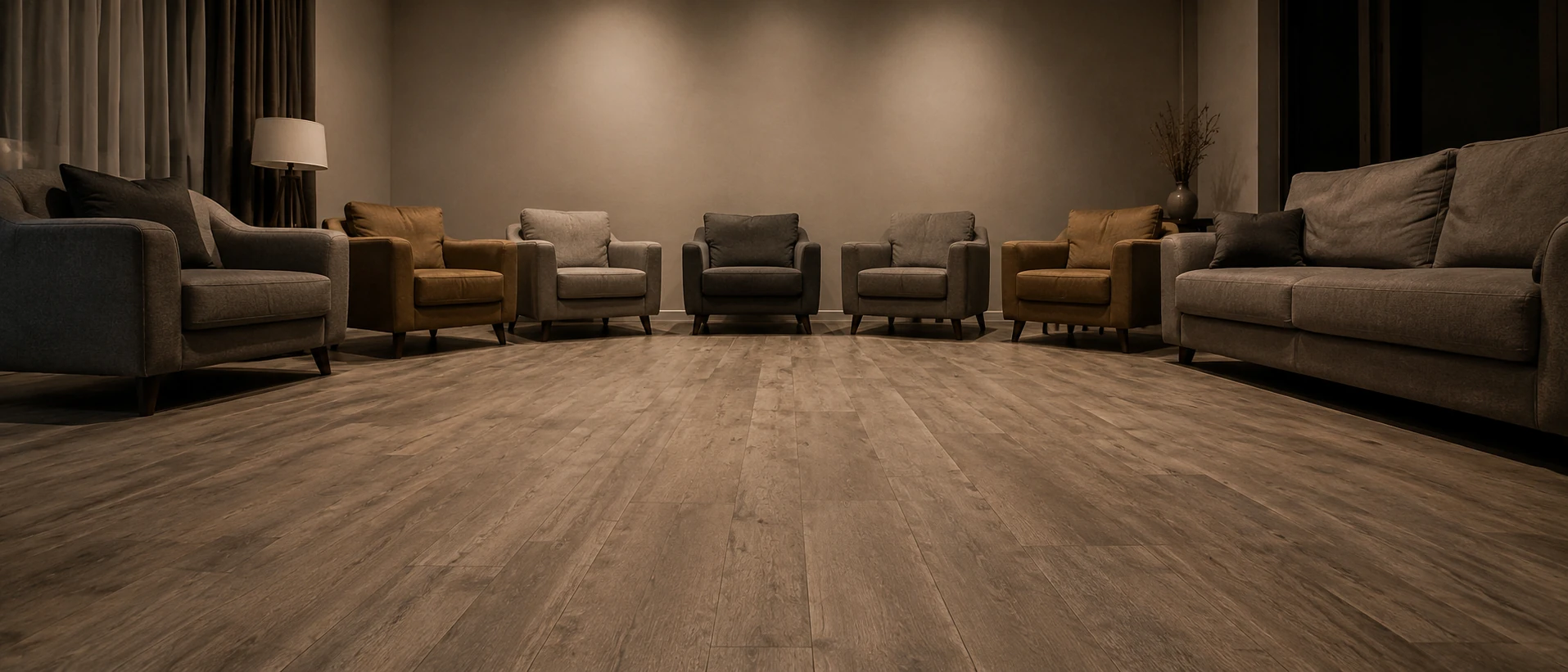
Another thing that changes a lot here is the seating. A half circle facing the performance area beats a ring closed on every side, because it keeps a way through at the edges and leaves the performer somewhere to step back to.
Where does the pole fit in?
When a pole was booked, its block usually sits after the interaction and before the finish, and it runs five to eight minutes. The reason for that order is that the pole needs an audience already focused, and at the start of the evening attention is still scattered.
This block differs from the rest, because it is more acrobatic than it is dance, and it asks the group to sit and watch rather than take part. Details on the format live under strippers on the pole.
If no pole was booked, that time is split between the other blocks and does not disappear. In that case the show gives more minutes to the interactive part and to the finish, and the total length stays the same.

The costume change and the second block
In most formats there is a halfway point where the stripper steps out to the side room for a moment and changes costume. The break is short, two to three minutes, and it is not dead time. It is what lets the second half open differently from the first.
The block that follows is usually more intense than the first, because the audience is already warm and the new costume changes the tone. In larger productions this is also the moment when another performer enters, and a group production with several strippers builds up without the transition feeling artificial.
Anyone who booked several performers will see the biggest difference here. In a single show the change is a break. In a show with several participants there is no break at all, because one carries the room while the other changes.
Points that keep coming back
How long does the show run in full?
An hour is the standard length, and in extended formats it reaches an hour and a half. The count includes the preparation and the finish, not only the dance blocks themselves.
What do the guests do during the preparation?
They carry on with the evening as normal. Standing in front of the door in anticipation creates pointless tension, while a group that stays in its own rhythm walks into the entrance with a much better reaction.
Can you ask for a different order of blocks?
Yes, and that gets settled in the booking call, not once the evening is already running. The standard order was built from experience, but there are situations where moving a certain part suits the group better.
What happens if a guest walks in halfway through?
The show carries on. Whoever comes in sits down quietly in the back row, without crossing the centre and without breaking the flow. That is why it helps if everyone is in the room before the start.
How does the second block differ from the first?
The difference is clear. The first builds tempo and gets to know the room, while the second already works on a warm audience and is therefore more intense. The costume change sits between them precisely to mark that shift.
What if the group is very small?
The structure stays, but the proportions change. In a group of four or five the interactive part grows, because attention does not have to be divided across a wide room.
Can you film during the show?
Only with explicit permission given in advance. In most evenings the group agrees not to film at all, and that is also what lets everyone be present in the moment.
What exactly is not included in the programme?
It all stays within dance, for grown-ups only. Close physical contact and anything sexual cannot be booked and form no part of any stage.
How does the show end?
The finish is not a sudden cut but a deliberate wind-down running five to seven minutes. The tempo drops gradually, the performance returns to the centre of the room and the last movements are calmer than everything before them.
After the finish there are usually a few minutes of group photographs, if that was agreed in advance, and a word from the guest of honour. It is a short part and it belongs to the group rather than to the show.
Worth noting that this part is not inside the show, so it is flexible. Some groups skip it entirely and move straight on with the rest of the evening.
Then comes the departure itself, and it is quick. The stripper goes back to the closed corner, gets dressed and leaves, and whoever booked opens the door for her. From the last movement to the door closing, a few minutes.
What happens when something goes wrong mid-show
Not every evening runs by the book, and most faults land on three things: the music, the light and the guests. Each of them has a solution that takes under a minute.
If the speaker drops out or the connection cuts, the show carries on quietly for a few seconds while one person deals with it. That is why it matters that one person is responsible for the music and not four.
If a particular guest crosses the line, the answer is not confrontation but a quiet redirect. Whoever booked moves him aside, the show continues, and the group barely notices.
And if the room simply does not work, the show can move to another corner of the house between two blocks. That happens when the space is too narrow, or a piece of furniture was left in the middle. That is a one minute transition, and it beats a cramped show that runs to the end only because nobody wanted to interrupt.
The timetable at a glance
The ranges below refer to a show of about an hour. In longer formats every block stretches proportionally, and the order itself stays.
- Meeting the coordinator and preparation, 7 to 13 minutes
- Entrance in character or direct entrance, 2 to 3 minutes
- First dance block, about 10 minutes
- Interactive part with the group and the guest of honour, 10 to 15 minutes
- Pole block, 5 to 8 minutes, if booked
- Costume change, 2 to 3 minutes
- Second block, about 10 minutes
- Finish and wind-down, 5 to 7 minutes
What does not happen in the show
Some of the expectations people bring with them are simply not part of the programme, and it is better to know that before rather than halfway through.
- There is no stage where guests get up and dance along with the performance
- There is no spontaneous extension without agreeing the time and the format first
- There is no switching format mid-show, for instance moving from solo to a duo on the fly
- There is no filming without permission, not even for private use
- Nothing in the programme involves physical intimacy or anything sexual
That list is not rigidity but the opposite. It is what lets everything else flow. A group that knows in advance where the line runs enjoys the evening more, because nobody spends it testing the edges.
What changes the structure
Three things move the proportions between the blocks. The first is the format. A single show with one stripper leans more on interaction, while a show with several performers leans on the wide blocks.
The second is the size of the space. In a small room the interactive part comes more naturally, while in an open space the wide blocks work better. The third is the group itself, since a quiet group gets a calmer build and a loud one gets a faster one.
Every available format is listed under the full range of stripper shows. Who performs in each of them can be seen in the photo gallery of the strippers.
The line that does not move across any of the stages
One sentence holds for every stage above. Everything described belongs to adult entertainment for over-eighteens, and no stage of it crosses into physical intimacy or anything sexual. How close anyone gets is decided by the performer herself, equally at the entrance, in the interaction and at the finish.
Passing this on to the group is the job of whoever made the booking. He is the only one who spoke to the other side before the evening. Two lines in the group chat the day before are completely enough.
Three conclusions
The first: the show is a structure, not a random sequence. The entrance builds expectation, the first block builds tempo, the interaction is the peak and the finish brings it down gradually. Anyone who knows the order does not try to drag the peak to the start of the evening.
The second: most of what affects the result is settled before the entrance. Five details in the conversation with the coordinator, a room with a door, music somebody is responsible for, dimmed light and an agreement about filming. That is almost all of it.
The third: the group's role is bigger than it seems. Staying in place, keeping the centre clear and respecting the agreed line are what turn the same performance from average into good. Anyone who wants to plan a whole evening around it will find the stages in the bachelor party guide. Anyone weighing up formats can check what affects the price of the show.
Ready to Book?
Contact us 24/7 — fast response, complete discretion.
Comments
Leave a Comment
Please log in to leave a comment.